Table of Contents
- Why This Decision Is Harder Than It Looks
- What a Real Digital Marketing Agency Actually Does
- 15 Questions to Ask Any Agency Before You Sign
- 8 Red Flags That Should Make You Walk Away
- Channel Comparison: Google Ads vs Meta vs LinkedIn vs SEO
- Agency vs Freelancer vs In-House: Which Is Right for You?
- What “Good” Actually Looks Like After 90 Days
- Why Business Owners Choose ECOMJETS
- FAQ
A business owner I worked with a few years ago hired a Google Ads agency based almost entirely on a polished proposal deck and a confident sales call. Six months and $40,000 in ad spend later, she had a folder full of reports showing “strong impression share” and “improving quality scores” — and virtually no new customers to show for it.
This isn’t a rare story. It plays out constantly, especially in Canada where the market for digital marketing services has expanded faster than most business owners’ ability to evaluate what they’re actually buying. The agency was technically running ads. They just weren’t running her business.
This guide is for business owners who are actively considering hiring a Google Ads agency, a Facebook ads agency Toronto, or any digital marketing agency — and who want a real framework for making that decision well. We’re going to go beyond the usual “check their portfolio” advice and get into the specific questions, the specific red flags, and the specific benchmarks that actually separate a partner who grows your business from one who just invoices it.
Written from the perspective of a digital marketing strategist with over a decade managing multi-channel campaigns for eCommerce brands, local service businesses, and B2B companies across North America.
Why This Decision Is Harder Than It Looks
The challenge with hiring a digital marketing agency isn’t that good agencies are hard to find. It’s that the signals that make an agency look credible — a professional website, polished case studies, confident salespeople — are essentially free to manufacture. Any agency can claim to be a certified Google Ads expert near me or a meta advertising partner. The certification is real; the competence it implies is variable.
What makes this harder in 2025 is the sheer number of options. Search “Google ads agency near me,” “Facebook ads agency Toronto,” or “SEO expert in Canada,” and you’ll find pages of results ranging from genuinely excellent operators to reseller operations running your account on autopilot from a dashboard you never see. The price range for similar-sounding services can vary by a factor of ten.
The other complicating factor: digital marketing results take time. This is a feature, not a bug — but it means that a mediocre agency can collect 3–6 months of retainer before you have enough data to clearly evaluate whether they’re actually delivering. By the time most business owners realise something’s wrong, they’ve already spent significantly.
The good news is that bad agencies have consistent tells. They ask bad questions (or no questions). They make promises that good agencies never make. They structure contracts in ways that protect them, not you. And when you know exactly what to ask and what to watch for, the distinction becomes fairly clear fairly quickly.
What a Real Digital Marketing Agency Actually Does
Before we get into evaluation criteria, let’s be precise about what a full-service digital marketing agency should actually be doing. This matters because vague scope is one of the most common sources of disappointment in agency relationships — both parties thought they agreed on something different.
Paid Advertising (Google, Meta, LinkedIn, Amazon, Pinterest)
A credible Google Ads agency doesn’t just “run ads.” They build campaigns around your business goals — specific revenue targets, CPAs, or ROAS — and actively manage bidding strategies, audience testing, ad creative, landing page alignment, and conversion tracking. The same applies to a good Facebook ads agency: your Meta campaigns should be structured around your funnel, not just reach and impressions.
If you’re a B2B business, a specialist LinkedIn ads agency or LinkedIn ads agency near me will approach targeting fundamentally differently — ICP-driven account lists, job function and seniority targeting, and a longer conversion timeline than consumer platforms. The strategy for a pinterest ad agency differs again — visual-first, inspiration-stage targeting, often more relevant for consumer goods, home decor, and lifestyle brands.
And if you’re selling on Amazon, amazon ads services Toronto (or wherever you’re based) require platform-specific knowledge around Sponsored Products, Sponsored Brands, and ACOS optimisation that’s distinct from the rest of paid media. Agencies that claim equal excellence across all of these simultaneously should be questioned carefully.
SEO and Organic Search
A genuine SEO expert in Canada works on three interconnected pillars: technical SEO (site structure, page speed, indexing), on-page optimisation (keyword targeting, content quality, internal linking), and off-page authority building (earned links, citations, brand mentions). Local SEO services USA and Canada add a fourth layer: Google Business Profile optimisation, local citations, and map pack visibility for businesses serving specific geographic areas.
SEO is slower than paid media — meaningful results typically take 3–6 months — but the compounding return profile is significantly better. A good digital marketing service partner understands when to lean into SEO, when to use paid channels to bridge the gap, and how to make the two work together rather than treating them as competing line items.
Reporting and Strategy
The agency’s job doesn’t end when the campaign goes live. Ongoing strategic input — what’s working, what’s not, where to reallocate budget, what tests to run next — is where the real value of a mature agency relationship lives. If your agency’s reporting is limited to a monthly PDF of campaign screenshots, you’re not getting strategy. You’re getting documentation.
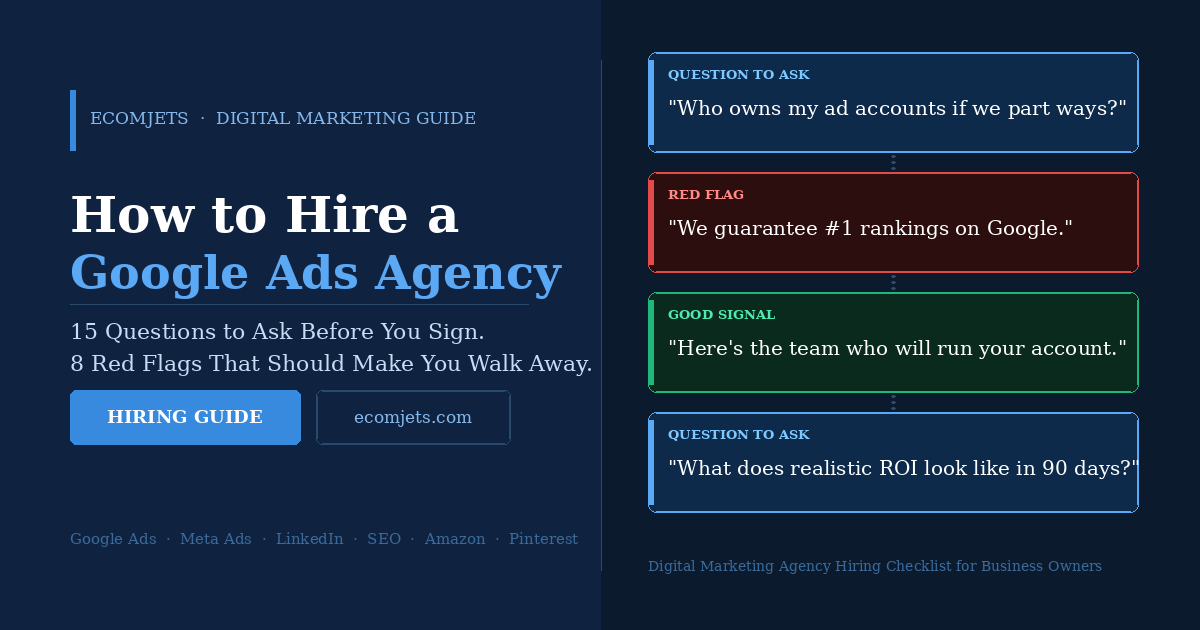
15 Questions to Ask Any Agency Before You Sign
These aren’t gotcha questions. They’re the natural questions that any serious business owner should be asking — and the answers will tell you a lot about how the agency thinks and operates.
On Strategy and Fit
- “What would you need to know about our business before recommending a channel mix?”
A good agency answers this question with more questions. A weak agency launches into a pitch about their services regardless of your situation. - “Have you worked with businesses in our industry or at our stage? Can you share specific results?”
Industry experience matters, but what you’re really evaluating is whether they can apply relevant learning to your situation — not just whether they’ve touched your category before. - “What does a realistic outcome look like in the first 90 days at our budget level?”
This question distinguishes honest operators from optimistic salespeople. A credible Google Ads agency will give you a range tied to your specific market, your current conversion infrastructure, and your margins — not a number designed to win the deal. - “What does underperformance look like, and what triggers a strategy review?”
Every agency talks about what happens when things go well. Ask about the process for when they don’t. The answer reveals accountability structures and whether they have any skin in the game.
On Execution and Team
- “Who specifically will be managing my account day-to-day? Can I meet them before signing?”
This is one of the most important questions you can ask. The people in the sales meeting are often not the people who will run your campaigns. Find out exactly who will, and assess them directly. - “What is the account manager’s current client load?”
An account manager juggling 25+ clients simultaneously cannot give your account meaningful strategic attention. Ask directly. Most won’t lie if asked plainly. - “Is any part of the work outsourced or white-labelled?”
There’s nothing inherently wrong with specialist subcontractors — but you should know if a significant portion of execution is happening at a third party you’ve never interacted with. - “What tools and platforms do you use, and will I have access to live data?”
You should have real-time access to your ad accounts, your analytics, and your reporting dashboard. Non-negotiable. If an agency hedges on this, it’s a serious concern.
On Reporting and Transparency
- “Can you show me a sample report from a current client?”
A well-structured report tells you whether the agency thinks analytically or just operationally. If it’s mostly charts without narrative — no interpretation, no next steps, no context — you’re looking at a documentation exercise, not a strategy update. - “What KPIs will you hold yourself accountable to, and how often will we review them?”
Look for business-outcome KPIs: revenue, ROAS, CPA, leads generated, conversion rate. Be cautious of agencies that lead with traffic, impressions, or engagement as primary success metrics for performance campaigns. - “Who owns the ad accounts, domain, and data if we part ways?”
You own everything. Always. If an agency structures their service so that your ad accounts or website are held in their name, that’s an ownership trap. Make sure this is explicit in the contract.
On Contracts and Commitments
- “What is the contract length, and what are the termination terms?”
A 90-day pilot on month-to-month terms before committing to an annual retainer is a reasonable ask. Agencies that refuse any form of short-term arrangement before proving value are protecting their revenue, not building your confidence. - “Are there any setup fees, minimum ad spends, or additional charges beyond the retainer?”
Get the full cost picture in writing. Creative production, landing page development, attribution tools, and platform fees can add substantially to the total cost of the engagement. - “What does your onboarding process look like in the first 30 days?”
Professional agencies have a structured onboarding: business audit, competitor analysis, goal alignment, account audit (if taking over existing campaigns), strategy documentation, and a defined 90-day roadmap. “We’ll get started on the campaigns” is not onboarding. - “What’s the most common reason your client relationships end, and what do you learn from it?”
This one catches agencies off guard. The honest answer is usually revealing — either about their actual service quality, their ideal client profile, or both.
8 Red Flags That Should Make You Walk Away
Most bad agency experiences are predictable. The warning signs are almost always visible before the contract is signed — but easy to overlook when the proposal deck is polished and the pitch is confident. Here’s what to watch for:
| Red Flag | What It Usually Means | What to Do |
|---|---|---|
| Guaranteed results or rankings | No legitimate agency guarantees outcomes in a live auction environment | Ask them to define what they’ll do if the guarantee isn’t met |
| Vague or generic proposal | They’re using a template, not building a strategy for your business | Ask how this proposal differs from what they’d send a competitor in your space |
| High-pressure close tactics | They need your revenue more than they’re confident in their value | Take the time you need regardless of any “offer expiry” pressure |
| Can’t produce a real client reference | Either the results don’t exist or clients aren’t willing to vouch for them | Request to speak with a current client, not just see a written testimonial |
| Senior pitch, junior execution | Your account will be managed by someone you’ve never met | Meet the actual account team before signing, not just the sales contact |
| Reports focused on vanity metrics | They’re optimising for what looks impressive, not what grows your business | Ask to see a sample report and check whether it connects to revenue |
| Ambiguity about account ownership | They’re building dependency to prevent you from leaving | Require written confirmation that all accounts and data remain yours |
| No questions about your business | A good agency interviews you. If they don’t ask about your margins, your customer, your competition — they’re not building a strategy | Walk away. Serious partners ask serious questions |
One pattern worth calling out specifically: the agency that talks fluently about what they do but never asks about what you need. A serious digital marketing agency should interview you as rigorously as you interview them. If they don’t understand your margins, your customer acquisition economics, your competitive landscape, and your sales capacity — they cannot build a strategy that actually fits your business. They can only build one that fits their service menu.
Channel Comparison: Google Ads vs Meta vs LinkedIn vs SEO
One of the most consequential decisions in working with a digital marketing service is channel allocation. Which platforms actually make sense for your business — and in what combination? Here’s a practical breakdown:
| Channel | Best For | Time to Results | Typical Strength | Key Specialist |
|---|---|---|---|---|
| Google Ads | High-intent search demand; products & services people are actively searching for | 2–4 weeks | Conversion-focused, measurable ROAS | Google Ads Agency |
| Meta (Facebook / Instagram) | eCommerce, consumer brands, visual products, B2C lead generation | 2–6 weeks | Audience building, retargeting, creative testing | Meta Ads Agency |
| LinkedIn Ads | B2B companies targeting by job title, company size, or industry | 4–8 weeks | ICP precision targeting; high-value lead generation | LinkedIn Ads Agency |
| Amazon Ads | Product sellers with active Amazon listings | 2–4 weeks | Buy-intent traffic directly on marketplace | Amazon Ads Agency |
| Pinterest Ads | Consumer goods, home, lifestyle, fashion, food brands | 4–8 weeks | Discovery-phase traffic with purchase intent | Pinterest Ads Agency |
| SEO / Local SEO | Any business that wants compounding organic traffic; local businesses needing map visibility | 3–6 months | Lowest long-term CPA; sustainable traffic growth | SEO Agency Canada |
The right channel mix depends on your business model, your customer acquisition economics, and your current growth stage. A new eCommerce brand with no organic traffic might start with Google Ads and Meta in parallel while building SEO in the background. A B2B SaaS company might focus on LinkedIn ads alongside content-driven SEO. A local service business in Toronto needs local SEO services and potentially Google Ads as the primary channels before anything else.
Any agency that recommends the same channel mix regardless of your situation is templating, not strategising.
Agency vs Freelancer vs In-House: Which Is Right for You?
The question of who to hire is separate from which agency to hire. Before you commit to an agency model at all, it’s worth being honest about whether it’s the right fit for your current stage.
| Model | Best For | Advantages | Limitations | Typical Monthly Cost |
|---|---|---|---|---|
| Full-Service Agency | Businesses with $5K+/month ad budget or multi-channel needs | Breadth of expertise; cross-channel coordination; accountability structures | Higher cost; quality varies significantly between agencies | $2,000–$10,000+ |
| Specialist Freelancer | Single-channel needs (e.g., Google Ads only) or tight budget | Cost-effective; direct access to the person doing the work | Limited bandwidth; no cross-channel coordination; key-person risk | $800–$3,000 |
| In-House Hire | Businesses spending $20K+/month on ads or with complex ongoing needs | Full business context; dedicated focus; institutional knowledge builds | High cost (salary + benefits); limited breadth; slow to hire right person | $5,000–$12,000+ |
| Hybrid (Agency + In-House) | Scaling brands that want execution breadth + internal strategy ownership | Best of both; in-house owns strategy, agency executes channels | Requires clear scope delineation to avoid overlap | Varies |
For most Canadian businesses in the $500K–$5M revenue range with meaningful digital acquisition needs, a full-service digital marketing agency with documented multi-channel experience is the most cost-effective model. You get access to specialists across Google, Meta, SEO, and other channels without the overhead of building an equivalent team internally.
What “Good” Actually Looks Like After 90 Days
One of the most disorienting things about hiring a digital marketing agency for the first time is not knowing what success should look like in the early weeks. Here’s a realistic benchmark framework:
Days 1–30: Foundation and Audit
A serious agency spends the first month building the structural foundation rather than rushing into spend. This means: a thorough account audit (if taking over existing campaigns), pixel and conversion tracking verification, competitor and keyword research, audience mapping, and a documented strategy with 90-day targets. If your agency skips the audit phase and starts running ads within the first week, that’s worth questioning.
Days 30–60: Launch and Initial Data
Campaigns launch with structured testing — not one winning hypothesis but multiple creative and audience variants designed to generate comparative data. You should be seeing weekly check-ins, initial CPC and CTR data, and early conversion signals. This is a learning phase; expect iteration, not immediate stable results.
Days 60–90: Optimisation and Direction
By day 90, you should have a clear picture of what’s working and what’s been cut. ROAS or CPA trends should be directionally positive even if not at target. Your agency should be able to tell you specifically why the results are at their current level, what the limiting factors are, and what the next 90-day strategy looks like. If they can’t, that’s the moment to have a frank conversation.
The honest caveat: paid media at the Google Ads agency level can show meaningful directional data within 30–60 days. SEO from an SEO expert in Canada takes longer — 3–6 months for meaningful organic movement is realistic and not a sign of underperformance. Managing the timeline expectations correctly is part of what separates a well-run agency relationship from a frustrating one.
Why Business Owners Choose ECOMJETS
I want to be direct about this section: there are good agencies in Canada. ECOMJETS is one of them — but the reason to consider them specifically isn’t the certifications or the polished website. It’s the way they’re structured and how they operate.
ECOMJETS is a performance-focused digital marketing agency based in Canada offering managed services across Google Ads, Meta advertising, LinkedIn Ads, Amazon Ads, Pinterest Ads, SEO, TikTok Ads, and eCommerce website development. What distinguishes their approach from agencies that promise the moon is a set of structural commitments that matter in practice:
- You own your accounts. Ad accounts, analytics, domain — all yours. Always. No hostage dynamics.
- Strategy precedes execution. The onboarding process is structured around understanding your business before recommending channels or building campaigns.
- Reporting is connected to revenue, not vanity metrics. ECOMJETS reporting is built around the KPIs that actually matter: ROAS, CPA, conversion rate, and revenue contribution — not click counts and impression share.
- Cross-channel coordination. Whether you need a Google Ads agency working alongside a facebook ads agency Toronto strategy, or an SEO expert in Canada building organic foundations while paid campaigns run — ECOMJETS manages the full picture without the misalignment that comes from running multiple single-channel vendors.
Their work across eCommerce and local service businesses is documented in their case studies. If you’re evaluating options for digital marketing services and want to apply the framework in this guide to a specific agency, a strategy call with ECOMJETS is worth the time.
Frequently Asked Questions
The most-searched questions about hiring a Google Ads agency, Facebook Ads agency, and digital marketing services — answered directly.
How much does it cost to hire a Google Ads agency in Canada?
Most Google Ads agencies in Canada charge a monthly management fee of $1,500–$5,000 CAD plus your actual ad spend. Some charge a percentage of ad spend (typically 10–20%), while others use a flat retainer. Setup or onboarding fees of $500–$2,000 are common for new accounts. The management fee is separate from what you pay Google — make sure you understand both components before signing. ECOMJETS provides transparent pricing tied to deliverables rather than opaque retainer structures.
What is the difference between a Google Ads agency and a Facebook Ads agency?
A Google Ads agency specialises in search, shopping, display, and YouTube advertising on Google’s platforms — capturing users who are actively searching for what you offer. A Facebook Ads agency (or Meta advertising partner) specialises in paid social campaigns across Facebook and Instagram, which are better suited for interest-based targeting, audience building, and visual product discovery. Most full-service digital marketing agencies handle both, but the strategies, creative requirements, and optimisation approaches are fundamentally different. The right channel depends on your business model, customer, and goals.
How long does it take to see results from a digital marketing agency?
Paid advertising (Google Ads, Meta, LinkedIn) typically shows directional results within 30–60 days as campaigns build data and are optimised. Meaningful, stable performance usually takes 60–90 days. SEO is slower by design — realistic timelines for meaningful organic traffic improvement are 3–6 months. Local SEO services can show Google Business Profile impact in 4–8 weeks. Any agency promising significant results in under two weeks from paid media, or ranking improvements in under a month from SEO, should be questioned carefully.
What questions should I ask a digital marketing agency before hiring them?
The most important questions to ask include: Who will manage my account day-to-day (and can I meet them before signing)? What does a realistic outcome look like at my budget in the first 90 days? Who owns the ad accounts and data if we part ways? Can you show me a sample report? What KPIs will you report on, and how often? What does your onboarding process look like in the first 30 days? What triggers a strategy review if campaigns underperform? A good agency will ask you just as many questions as you ask them — if they don’t ask about your margins, customer, and goals, they’re not building a strategy.
What is local SEO and do I need it for my Canadian business?
Local SEO is the practice of optimising your online presence to appear in geographically relevant searches — “plumber near me,” “dentist Toronto,” and similar queries — including Google’s map pack results. If you serve customers in a specific city or region, local SEO is highly valuable. It involves Google Business Profile optimisation, local citation building, location-specific content, and reviews management. An SEO expert in Canada familiar with local search dynamics can generate significant organic visibility for service-area businesses without ongoing ad spend.
Should I hire a LinkedIn Ads agency for B2B lead generation?
If your target customer is a business decision-maker — by job title, company size, or industry — LinkedIn Ads is the most precise targeting tool available in digital advertising. The cost-per-click is higher than Google or Meta, but the audience quality for B2B purposes is unmatched. A specialist LinkedIn ads agency near you understands how to structure campaigns around your ICP, build proper lead generation funnels for the platform, and optimise for cost-per-qualified-lead rather than raw click volume. Not every B2B business needs LinkedIn Ads, but for those targeting senior buyers at mid-to-large companies, it’s often the highest-quality channel available.
What are the biggest red flags when hiring a digital marketing agency?
The biggest red flags include: guaranteed results or rankings (no legitimate agency can guarantee outcomes in a live auction environment), vague or templated proposals that don’t reflect your specific business, high-pressure tactics to sign quickly, inability to produce verifiable client references, ambiguity about who owns your ad accounts and data, reporting focused on vanity metrics like impressions rather than revenue-related KPIs, and an agency that pitches without asking meaningful questions about your business. If a sales process feels rushed, generic, or evasive, that’s usually an accurate preview of the client experience.
How do I know if my digital marketing agency is actually delivering results?
The clearest sign is a direct connection between your marketing spend and business outcomes — revenue, leads, or qualified traffic — that you can verify independently through your own analytics. If your only visibility into performance comes from reports the agency produces, ask for direct access to your ad accounts and Google Analytics. A trustworthy agency will not hesitate to give you full access. Beyond access, evaluate whether the agency can explain what’s working, what’s not, and what they’re changing based on the data — not just report numbers, but interpret them in the context of your business goals.
Final Thoughts
Hiring a Google Ads agency or any digital marketing agency is a high-stakes decision — not because the risk of hiring badly is catastrophic, but because the cost of a wrong choice is measured in months, not just money. Time spent with the wrong partner is time not spent building with the right one.
The framework in this guide isn’t complicated: ask specific questions, watch for specific patterns, demand specific accountability. A good agency welcomes all of it. They’ll ask you harder questions than you ask them, they’ll set realistic expectations rather than impressive ones, and they’ll be willing to earn your confidence before asking for a long-term commitment.
If you’re evaluating digital marketing services for your Canadian business right now — whether you need a Google Ads agency, a specialist in local SEO services, a LinkedIn ads agency for B2B growth, or full multi-channel management — ECOMJETS is worth a conversation. Apply the questions in this guide to them. They’ll give you straight answers.
Related reading: How to Choose the Right Digital Marketing Agency for Real Growth | Smart Business Owner’s Guide to a Profitable Digital Marketing Agency | Amazon Agency Canada: How to Hire the Right Partner | Why Your Website Traffic Is Low