You’ve got a budget. You’ve got a business to grow. And you’re staring at two options that every marketer, entrepreneur, and eCommerce founder eventually has to choose between: Google Ads or SEO. One costs money per click. The other costs time. Both promise results. But which one actually delivers the ROI your business needs right now — and which one builds the kind of long-term growth that compounds over time?
This isn’t a question with a simple answer. And anyone telling you to pick one and ignore the other is leaving money on the table. But understanding how each channel works, when to use it, and how to make them work together — that’s where real business growth lives. Let’s break it down.
The Core Difference: Speed vs. Sustainability
Before you can make an intelligent decision, you need to understand what you’re actually comparing. Google Ads and SEO are both about getting your business in front of people searching for what you offer — but the mechanics, timelines, and cost structures are fundamentally different.
What Google Ads Actually Does
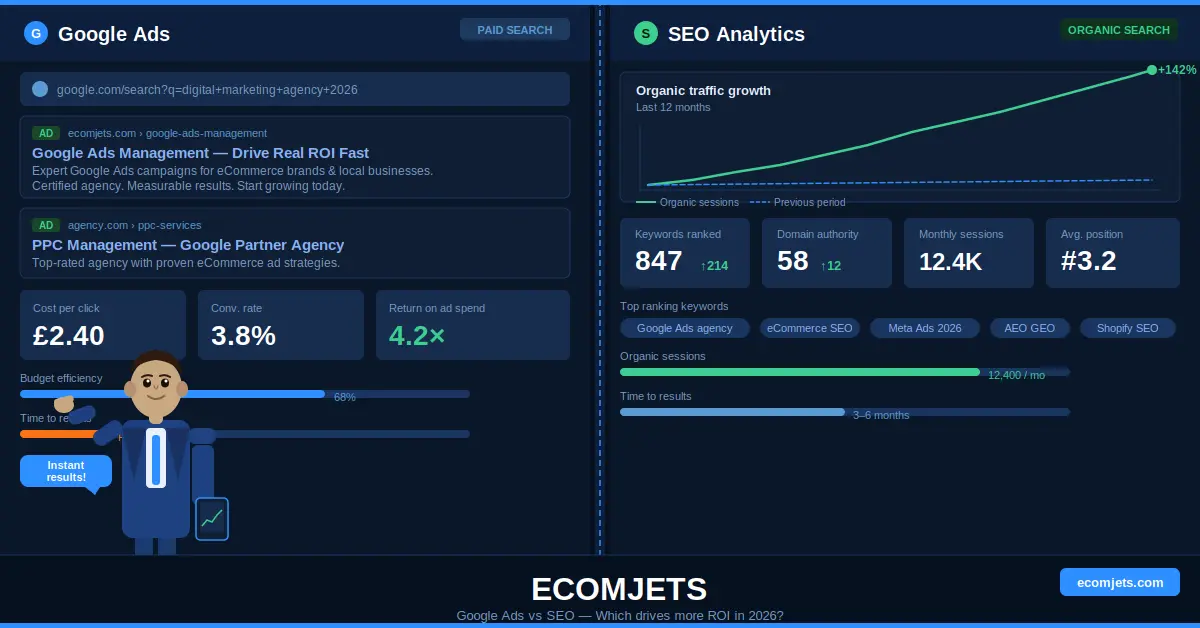
Google Ads (formerly Google AdWords) puts your business at the top of search results — immediately. You bid on keywords, write ad copy, set a budget, and within hours your business is visible to people actively searching for your product or service. You pay per click. The moment you stop paying, the traffic stops.
For businesses that need leads or sales now — a new product launch, a seasonal promotion, a competitive market where organic rankings take months to build — Google Ads is genuinely powerful. Done well, it delivers measurable, trackable ROI with a level of control that very few other channels match.
What SEO Actually Does
SEO (Search Engine Optimisation) builds your visibility in organic search results — the non-paid listings that appear below the ads. It involves optimising your website structure, creating authoritative content, building backlinks, and ensuring Google understands what your business offers and who it should show it to.
SEO takes time. Most businesses don’t see significant results for 3–6 months, sometimes longer in competitive industries. But the payoff is compounding: once you rank, you receive free traffic continuously. A page that ranks on page one of Google for a high-intent keyword can generate leads and sales for years — with zero ongoing ad spend attached to it.
ROI Breakdown: The Numbers Behind Each Channel
Return on investment is the only metric that ultimately matters for a business. Here’s how the two channels compare when you look beyond surface-level metrics and into what actually drives revenue.
Google Ads ROI: Fast, Measurable, Cost-Dependent
The average Google Ads return across industries is approximately $2 for every $1 spent — but this varies significantly based on industry, targeting quality, landing page performance, and campaign structure. For eCommerce brands and local service businesses with well-optimised campaigns, ROAS (return on ad spend) of 4x–8x is achievable with the right management.
The critical variable is conversion rate optimisation. Google Ads brings traffic — your landing page or website has to convert it. Poor landing page performance is the single biggest reason well-structured ad campaigns underperform. Clicks are only valuable when they turn into customers.
The cost side is also worth being honest about. In competitive sectors — insurance, legal services, home improvement, SaaS — cost-per-click can run anywhere from £5 to £50+. That means your margins, average order value, and customer lifetime value need to support the cost of acquisition. For Google Ads for small business owners with tighter margins, this calculation requires careful management.
SEO ROI: Slower to Build, Higher Long-Term Return
Studies consistently show that organic search delivers the highest ROI of any digital marketing channel over a 12–24 month period. The cost-per-acquisition from organic traffic drops dramatically over time as content assets continue generating traffic long after the initial investment.
For SEO for eCommerce specifically, the compound effect is significant. A well-optimised product category page or buying guide that ranks for high-intent keywords can generate consistent revenue without ongoing ad spend. That’s the kind of asset that builds real business value — not just this month’s revenue.
The honest caveat: SEO ROI is harder to attribute in the short term, and it requires sustained investment in content, technical optimisation, and authority building. It’s not a one-time project — it’s an ongoing channel that rewards consistency.
When to Use Google Ads (And When Not To)
Google Ads is the right choice — or at least the priority — in specific business situations. Here’s where it earns its budget:
- New business or website — You have no organic rankings yet. Google Ads gets you in front of customers while SEO builds in the background.
- Seasonal or time-sensitive offers — A Black Friday campaign, a product launch, a limited-time service promotion. SEO can’t be turned on overnight; Google Ads can.
- High-intent, transactional searches — When someone searches “buy running shoes online” or “emergency plumber London,” they’re ready to convert. Google Shopping and Search ads capture this intent at exactly the right moment.
- Testing new markets or products — Before investing months in SEO for a new product line, use Google Ads to validate demand and conversion rates quickly.
- Competitive markets where SEO takes years — In some industries, competing organically for top positions takes significant time and resource. Ads keep you visible while that work happens.
Where Google Ads struggles: brand awareness for low-intent audiences, content marketing objectives, and situations where your margins simply can’t support the cost-per-click in your category. In these cases, paid search alone won’t deliver sustainable growth.
When to Prioritise SEO (And Why It’s a Long-Term Asset)
SEO belongs at the centre of your digital marketing strategy if any of the following describe your situation:
- You’re building a brand for the long term — Organic visibility builds authority and trust in a way paid ads can’t replicate. Consumers trust organic results more than ads.
- Your category has high search volume and strong informational intent — If people are searching for information, comparisons, and guides related to what you sell, SEO-driven content is how you capture that audience before they’re ready to buy.
- Your ad costs are rising — As Google Ads competition increases in most categories, organic traffic becomes an increasingly valuable hedge against rising CPCs.
- You want to build compounding assets — Every well-ranked page is a business asset. Unlike ads, it doesn’t disappear when you stop paying.
- You run a Shopify store or eCommerce brand — Shopify SEO, product page optimisation, and content marketing are among the highest-ROI investments available to online retailers over a 12-month horizon.
The Smart Answer: Use Both — But Strategically
The businesses generating the strongest online growth in 2026 aren’t choosing between Google Ads and SEO. They’re using both — with intention, and with each channel doing the job it’s actually best at.
The Combined Strategy That Works
Here’s how an integrated approach typically looks for an eCommerce brand or service business:
- Phase 1 (Month 1–3): Google Ads drives immediate traffic and revenue while SEO foundations are built — technical audit, site structure, keyword research, and initial content.
- Phase 2 (Month 3–6): SEO content starts ranking for lower-competition, longer-tail keywords. Paid ads data reveals which keywords convert best — informing SEO content priorities.
- Phase 3 (Month 6–12+): Organic traffic builds and cost-per-acquisition from SEO drops. Google Ads budget is shifted toward high-value terms where paid placement remains worth the cost, while SEO handles informational and mid-funnel queries.
This is the model that agencies like ECOMJETS build for clients — not siloed campaigns, but integrated strategies where paid and organic channels reinforce each other. Google Ads data tells you what converts. SEO builds the long-term foundation. Together, they create a traffic engine that doesn’t break when one channel has a bad month.
What About Meta Ads, AEO, and GEO?
Google Ads and SEO are the two most-discussed channels — but they’re not the only ones shaping digital marketing ROI in 2026. A few developments worth understanding:
Meta Ads: The Awareness and Retargeting Layer
Facebook and Instagram advertising through Meta Ads serves a different purpose than Google Ads. Where Google captures existing demand (people searching for something), Meta creates demand — reaching people who fit your customer profile before they’ve started searching. For eCommerce brands, Meta Ads combined with Google remarketing creates a funnel that catches potential customers at every stage of the buying journey. ECOMJETS’ Meta Ads services are built specifically around this full-funnel approach.
AEO and GEO: The AI Search Frontier
Answer Engine Optimisation (AEO) and Generative Engine Optimisation (GEO) have moved from emerging concepts to active priorities for forward-thinking businesses. As Google’s AI Overviews and tools like ChatGPT increasingly answer search queries directly — without users clicking through to a website — appearing in those AI-generated answers requires a distinct content and authority strategy.
Businesses investing in AEO and GEO now are positioning themselves ahead of a shift that’s already underway. Structured content, authoritative sourcing, and clear entity-based SEO are the foundations. This is increasingly part of what a comprehensive SEO strategy needs to include in 2026.
5 Signs Your Current Digital Marketing Strategy Needs a Rethink
Not sure whether your current approach is working? Here are the signals worth paying attention to:
- Your cost-per-lead is rising month over month — Usually a sign of audience fatigue, poor targeting, or a landing page that isn’t converting efficiently.
- You’re completely dependent on paid ads for traffic — If your ads stopped tomorrow, would your business still generate leads? If the answer is no, you have a single point of failure.
- Your website gets traffic but doesn’t convert — Volume without conversion is an expensive problem. Conversion rate optimisation should be a priority before scaling ad spend.
- You don’t know which channel is driving your best customers — Without proper attribution and analytics, you’re making budget decisions on incomplete information.
- Your competitors consistently outrank you organically — Market share lost to organic competitors compounds over time. Every month you’re not ranking is a month they’re capturing your potential customers.
If any of these resonate, the conversation worth having isn’t “Google Ads or SEO” — it’s “what does a strategy that actually solves these problems look like?” That’s what ECOMJETS specialises in: Google Ads management, SEO services, Meta Ads, and integrated eCommerce marketing strategies built around real business outcomes.
Explore ECOMJETS Services
- SEO Services — Rank higher, get found, grow organically
- Google Ads Management — Performance-driven paid search campaigns
- Meta Ads Services — Facebook & Instagram advertising that converts
- TikTok Advertising — Reach the next generation of buyers
- Pinterest Marketing — Visual discovery for eCommerce brands
- Amazon Marketing — Dominate the world’s largest marketplace
- LinkedIn Marketing — B2B lead generation at scale
- Branding Agency — Build a brand that commands attention
The Bottom Line: Strategy Beats Channel Selection Every Time
The Google Ads vs. SEO debate is really a question about timing, budget, and business goals — not a permanent either/or decision. The most successful businesses treat both as complementary tools in the same growth system, not competing budget lines.
Start with the honest question: what does your business need most right now? Immediate revenue while you build long-term visibility? A sustainable traffic engine that reduces your dependence on paid spend? Better conversion of the traffic you already have? The right answer shapes the right strategy.
At ECOMJETS, we work with eCommerce brands, Shopify store owners, local businesses, and growing companies to build digital marketing strategies that are grounded in data, built for the long term, and designed to grow your business — not just your traffic numbers. If you’re ready to stop guessing and start growing, get in touch with our team and let’s talk about what’s actually possible for your business.
Frequently Asked Questions
How long does SEO take to show results?
Most businesses start seeing measurable SEO results within 3–6 months, with more significant ranking gains typically appearing at the 6–12 month mark. The timeline depends on several factors: how competitive your industry is, the current state of your website’s technical health, the quality and volume of content being produced, and the strength of your backlink profile. In less competitive niches or local markets, results can appear sooner. In highly competitive sectors — legal, finance, SaaS — the timeline may extend to 12–18 months before top-position rankings are achievable.
Is Google Ads worth it for small businesses with a limited budget?
Yes — but only with the right strategy. Google Ads can be highly effective for small businesses when campaigns are tightly focused on high-intent, specific keywords rather than broad terms with high competition. A small budget spent on well-targeted, localised, or niche-specific campaigns will consistently outperform the same budget spread across generic keywords. The key is ensuring your landing page converts the traffic you’re paying for. Without conversion optimisation, even a well-structured Google Ads campaign will underperform.
What is AEO (Answer Engine Optimisation) and do I need it?
Answer Engine Optimisation is the practice of structuring your website content to appear in AI-generated answers — such as Google’s AI Overviews, featured snippets, and responses generated by tools like ChatGPT and Perplexity. As more searches are answered directly by AI without users clicking through to websites, AEO is becoming a critical part of maintaining organic visibility. It involves creating clearly structured, authoritative content that answers specific questions comprehensively. If your business relies on organic search traffic, AEO should be part of your strategy in 2026.
What’s the difference between GEO and traditional SEO?
Traditional SEO focuses on ranking your web pages in Google’s standard search results. Generative Engine Optimisation (GEO) focuses on getting your brand, content, or data cited within AI-generated responses from large language models and AI search tools. GEO requires building clear topical authority, having well-structured and credible content, and ensuring your brand is referenced in authoritative third-party sources. It’s an evolution of SEO strategy rather than a replacement — but it requires a distinct content and authority-building approach.
How do I know if my Google Ads campaigns are actually performing well?
The primary metrics to track are cost-per-conversion (how much you’re paying for each lead or sale), conversion rate (what percentage of clicks become customers), ROAS (return on ad spend for eCommerce), and quality score (Google’s assessment of your ad relevance and landing page experience). High click-through rates with low conversion rates typically signal a landing page or targeting problem. High impressions with low clicks usually indicate ad copy that isn’t compelling or targeting that’s too broad. Good campaign performance means your cost-per-acquisition is sustainably below your margin threshold.
Should I run Google Ads and SEO at the same time?
In most cases, yes — and this is the approach that consistently delivers the best results. Running both simultaneously means Google Ads generates immediate revenue while your SEO builds organic visibility in the background. Paid search data also provides invaluable insight into which keywords drive the best conversions, informing your SEO content priorities. Over time, as organic rankings improve, you can shift ad budget toward the highest-value terms where paid placement still earns its cost, while SEO handles the rest. The two channels work better together than either does alone.
What makes eCommerce SEO different from standard SEO?
eCommerce SEO has specific challenges and opportunities that don’t apply to standard informational websites. Product pages, category pages, and filters can create thousands of URLs — many with duplicate or thin content — which need careful technical management. Product schema markup, review integration, and inventory-aware content are all eCommerce-specific. eCommerce SEO also places a strong emphasis on transactional keyword targeting, internal linking between product and category pages, and content marketing strategies that capture buyers at the research stage before purchase intent fully crystallises.
How much should a business spend on digital marketing?
A common benchmark is allocating 7–12% of revenue to marketing, with digital channels taking an increasing share of that budget for most businesses. For early-stage businesses or those in competitive markets, investment may need to be higher to build visibility quickly. The more useful question is what your customer acquisition cost needs to be to remain profitable — and building your budget around that number rather than an arbitrary percentage. A well-managed combination of paid advertising and SEO typically delivers a lower blended cost-per-acquisition than relying on either channel alone.